Annex X - Exempted food products from date labelling
Date labelling non-perishables leads to unnecessary food waste
Misunderstood date labeling contributes to nearly 10% of consumer food waste, as many mistake "best before" (quality) for "use by" (safety). A 2015 Eurobarometer survey found that less than half of EU consumers fully understand date marking, leading to unnecessary disposal—especially of non-perishables. Research shows that removing date labels from long-shelf-life products reduces waste by 31%. To address this, the EU could expand the list of non-perishables exempt from mandatory date marking under Regulation (EU) No 1169/2011 Annex X.
A First Step Solution: Extending the Exemption List
Under current regulations, certain non-perishable products—like salt, sugar, and vinegar—are already exempt from mandatory date marking. We propose adding extra non-perishable products to this list that:
Share the same characteristics with already-exempted items, such as low moisture content, shelf stability, and resistance to microbial spoilage.
Are confirmed by a Dutch advisory bodies, called BuRo[i], to pose no safety risks when stored correctly.
These products are:
Dry pasta
Couscous/Semolina
Coffee
Tea
Rice
Instant powders (with low-fat content)
Dried spices
Flour
Bottled drinkable water
Specific canned products (meeting established safety criteria)*
[i] Advies over mogelijkheden voor uitbreiding van de lijst met producten die uitgezonderd zijn van de verplichting voor een vermelding van een houdbaarheidsdatum, BuRo (2016).
The Benefits: A Win-Win for all
1. Empowering Consumers and Reducing Waste
Removing date marks from non-perishable items encourages consumers to rely on sensory cues and common sense, reducing unnecessary food disposal. Studies by WRAP[i] and others[ii,iii] demonstrate that this simple change could significantly lower household food waste.
2. Environmental Impact
By preventing millions of kilograms of food waste annually, this measure aligns with the EU’s Farm to Fork Strategy goals, including halving food waste by 2030 and reducing greenhouse gas emissions. For example, eliminating date labels on dry pasta alone could save an estimated 3 million kilograms of food each year in the EU**.
3. Economic and Business Advantages
For Consumers: Households save money by using food more efficiently.
For Businesses: Simplified labeling reduces costs and minimizes logistical complexities, reduction of scope 3 CO2 emissions.
For Governments: Lower waste management costs, progress toward binding food waste reduction targets (30% by 2030) and CO2 reduction targets (on average,1 kg of consumer food waste equals 2.96 kg CO2e)[iii]
[i] Consumer insight: Date labels and food waste. WRAP (2011).
[ii] The effect of date marking terminology of products with a long shelf life on food discarding behaviour of consumers, Holthuysen et al (2017).
[iii] Impact of date labeling on consumer behavior. Food Quality and Preference (2019).
[iv] Annex Voedselverspilling bij consumenten thuis in Nederland in 2022, Chapter 7 (2022).

Support the amendment
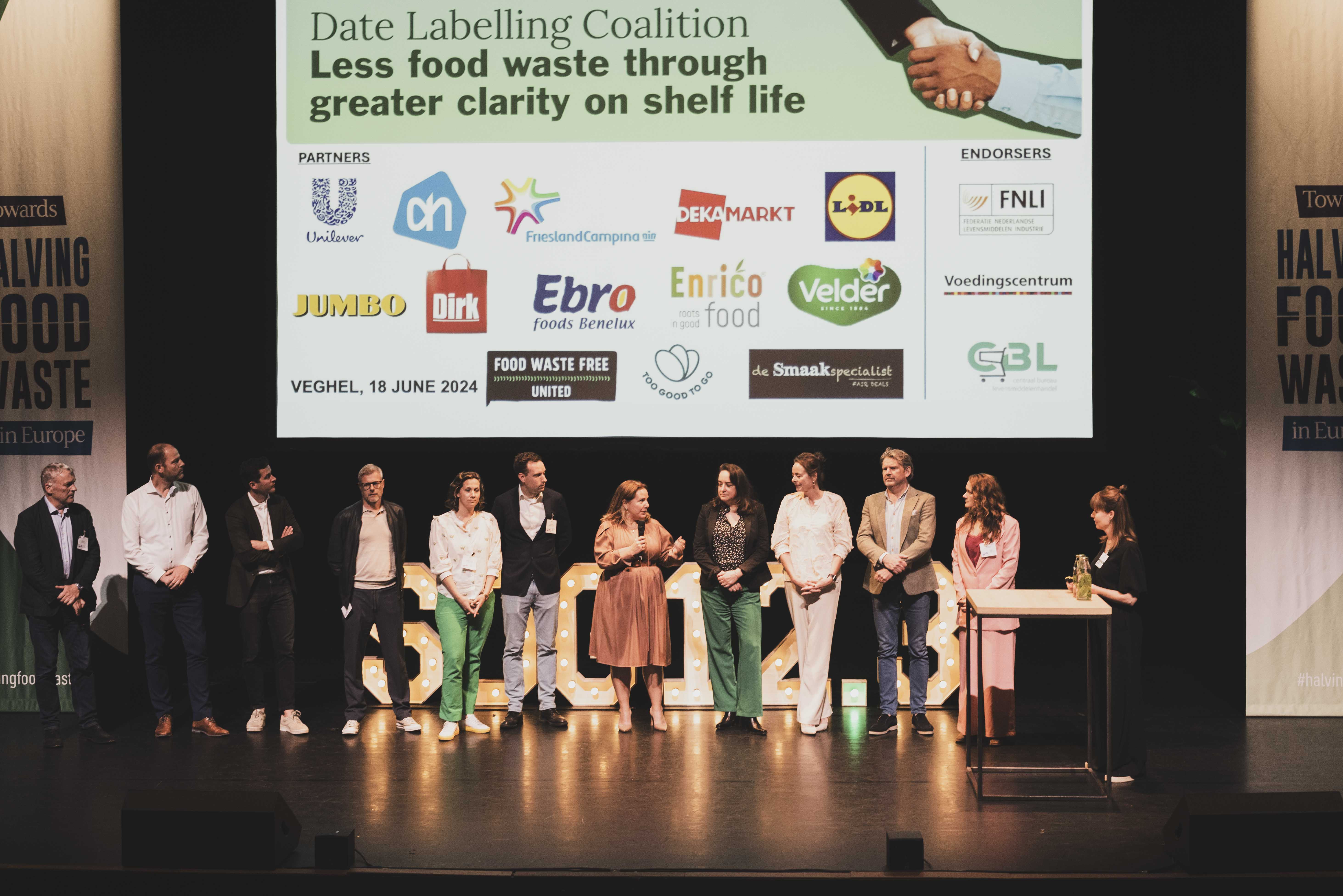
List of signatories:
FNLI
CBL
Ministerie van landbouw, Visserij, Voedselzekerheid en Natuur
Voedingscentrum
Unilever
Albert Heijn
Friesland Campina
Dekamarkt
Jumbo
Dirk
Ebro Foods Benelux
Enrico Food
Velder
Too Good To Go
De Smaakspecialist
Food Waste Free United